Should you worry about AI taking your job? (Sep 2026)
Separate exposure from job loss
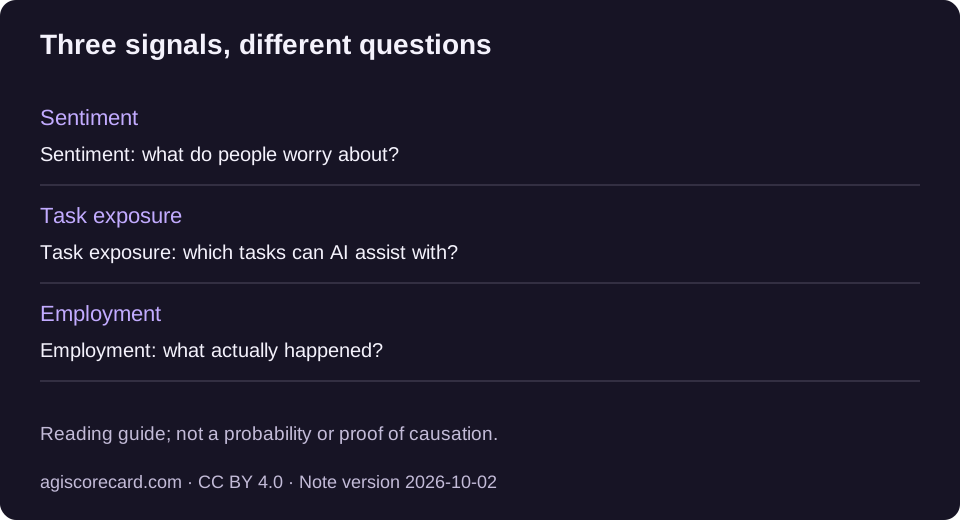
Sentiment, task exposure and observed employment answer different questions. Use the dated studies below to inspect a specific task and cohort; do not convert a task-exposure percentage into a probability of losing your job.
Citation note version: · Ledger date:
Inspect sources and scope
Sources may evolve. Retain their study window when citing. The note version does not mean the entire older article was reassessed.
AGI Scorecard. Separate exposure from job loss. Citation note version 2026-10-02; ledger 2026-09-06. https://agiscorecard.com/ai-and-your-job. CC BY 4.0.
Use the evidence to make your assessment- Fear79% of Americans expect AI to reduce US jobs over the next 10 years; 18% of workers think their own job is likely gone within 5 years (Gallup, 2026).
- Economy-wide, observedUS unemployment 4.2%, no relative deterioration in AI-exposed occupations in aggregate (Anthropic economist Peter McCrory, Fortune, 2026-07-24); no discernible economy-wide disruption (Yale Budget Lab tracker).
- Concentrated early signalWorkers aged 22–25 in the most AI-exposed occupations: relative employment −13% (Aug 2025) → −16% (Nov 2025) → a gap of about 19% (Aug 2026 update, data through Jun 2026) (Stanford Digital Economy Lab, Canaries).
Three signals, three answers
Polls measure fear; exposure studies measure which tasks a model can touch; employment data measures what has happened.
| Signal | Latest reading (dated) | What it can and cannot tell you | Source |
|---|---|---|---|
| Fear |
| Can: show sentiment, rising every year on record. Cannot: show whether jobs are being lost. The Gallup gap (79% for the country vs 18% for one's own job) says people fear for others more than themselves. | Gallup · Pew · APA |
| Exposure |
| Can: rank which occupations' tasks AI does or could do. Cannot: predict employment — the authors say so themselves. Precedent: Frey & Osborne's 2013 "47% at risk", graded a poor predictor by ITIF. | Microsoft · Eloundou · Anthropic · ITIF |
| Observed employment |
| Can: tell you what has happened, with a lag. Cannot: tell you the future; and Challenger counts employer-stated reasons, not verified causes. | Stanford · Yale · Challenger · BLS |
How to read your own situation
The principle behind every jobs verdict here is the autonomy gap: exposure is not replacement. A model observed doing 49% of a translator's work activities has not taken the translator's job. What raises your risk is when the unsupervised, end-to-end judgment in your role — the part nobody checks before it counts — becomes something a system does reliably alone. The same gap keeps our knowledge-work verdict at On track rather than Done, and mass unemployment at not yet.
Ask three questions of your own job. How much of it is unsupervised end-to-end judgment versus supervised, physical, or relational work? The safe-jobs analysis maps the categories. Are you early-career in an exposed field? The Canaries gap is specific to ages 22–25, and Indeed Hiring Lab found 71% of software-development posting growth (May 2025→May 2026) was senior-level. Does the data split your field? For software it does — BLS projects programmers −6% but developers +15% through 2034, which the programmers page takes apart. Look up your occupation.
How soon do you think the labor shock lands?
One tap — see which real forecaster you side with, instantly. No sign-up.
What would change this verdict
A graded call comes with the conditions that flip it. Next review: 2026-10-03.
- Flips to "worry more" if, at review, the Yale Budget Lab tracker reports discernible economy-wide disruption; the Canaries gap for ages 22–25 widens beyond 25%, or a comparable gap appears for ages 26–35; or US unemployment is above 5% while AI-cited cuts exceed 40% of Challenger's monthly total for three consecutive months.
- Flips to "worry less" if the Canaries gap narrows below 10% in two consecutive updates.
Worry audit: what to do this year
57% of US adults call the rise of AI a significant source of stress (APA Stress in America, 2025). The relief this site can offer is calibration — worry sized to evidence, each item tagged to its signal.
- Separate the country's risk from yours [Fear] — Gallup's respondents put the country at 79% and themselves at 18%. Note which one you are reacting to.
- Look up your occupation, not your industry [Exposure] — programmers (−6%) vs developers (+15%) shows how much a title hides. Check yours.
- If you are 22–25 in an exposed field, treat the Canaries number as real [Observed] — it has grown at every update; move toward the judgment-owning end of your role. If you are mid-career, the same data shows no comparable decline — re-check on 2026-10-03, not daily.
- Read "AI-cited" layoffs as a stated reason [Observed] — 112,713 announced cuts cited AI through July; a citation is not a verified cause.
Frequently asked questions
Not economy-wide, as of September 2026: US unemployment is 4.2% and the Yale Budget Lab tracker finds no discernible disruption from AI. The one hard signal is concentrated — Stanford's Canaries study puts workers aged 22–25 in the most AI-exposed occupations at a relative employment gap of about 19% (data through June 2026), with no comparable decline for older workers.
By observed use, Microsoft's Working with AI study (July 2025) scores 785 occupations; Interpreters and Translators rank highest at 0.49. By theoretical exposure, Eloundou et al. (Science, 2024) put about 80% of US workers at 10%+ of tasks exposed to LLMs and about 19% at 50%+. Exposure measures which tasks AI can touch, not job loss.
The data splits the field, not the degree. BLS projects 2024–34 computer programmers −6% but software developers +15% and data scientists +33.5%. As reported by secondary sources citing NY Fed recent-graduate data, unemployment is 6.1% for computer science majors and 7.5% for computer engineering; CS enrollment for 2025–26 fell by roughly 8–11% according to reports citing National Student Clearinghouse data.
In proportion to your situation, not the headlines. 57% of US adults call the rise of AI a significant source of stress (APA, 2025), yet economy-wide employment data shows no discernible AI disruption so far. Worry more if you are early-career in a highly exposed occupation doing unsupervised end-to-end judgment a system can already do; worry less if your role is supervising, deciding, or physically present. Re-checked 2026-10-03.
Sister ledger: AI Gold Rush Ledger — the mirror question — who is actually making money with AI — graded the same way.
Be first to know when this verdict flips
One email when a verdict flips and the Thesis Tracker moves. Nothing arrives until the score actually moves.
Subscribe free →